
Five ways your past experiences quietly rewrite what you see on gallery walls
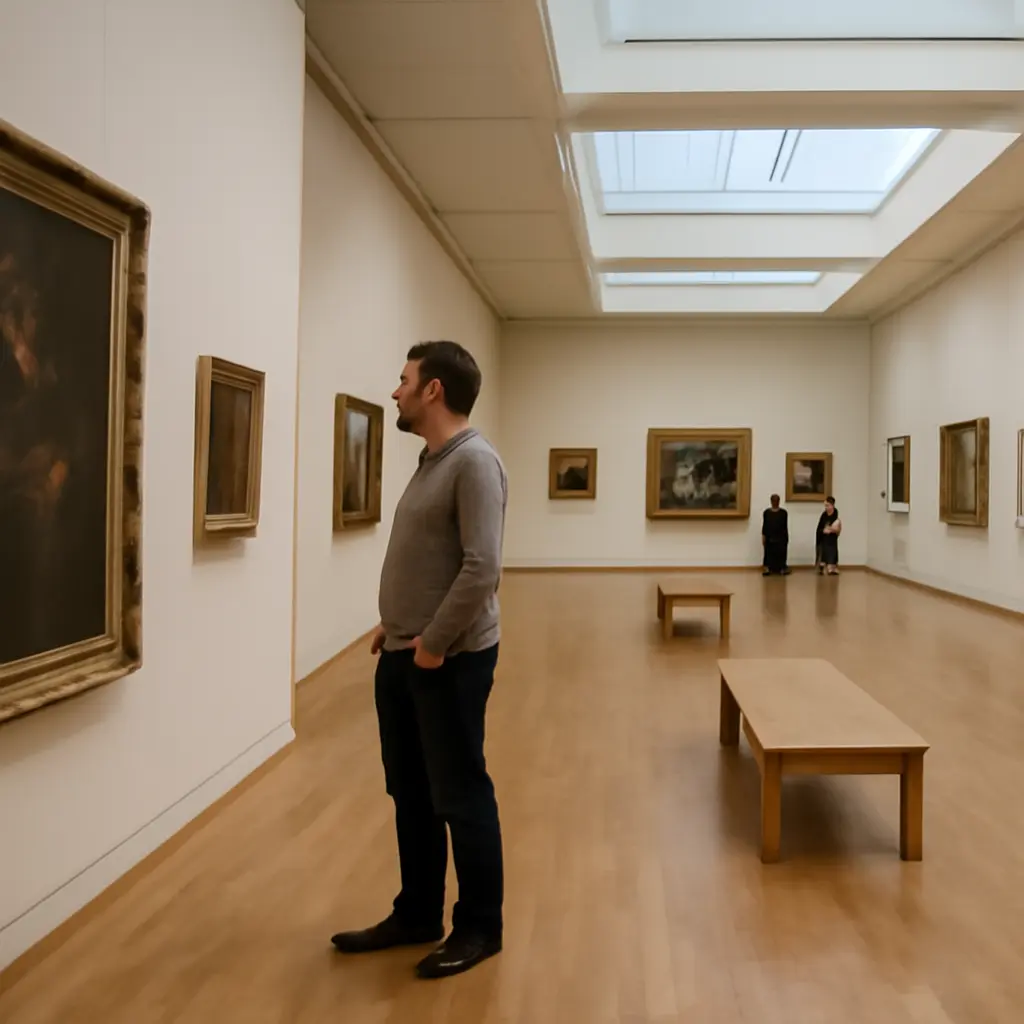
Personal history and visual perception: Five ways your past experiences quietly rewrite what you see on gallery walls
A gallery visitor never meets an artwork with a completely blank mind: visual perception is the process of organizing and interpreting sensory information, and memory, expectations, culture, and emotion help shape that interpretation. Research in psychology and museum studies supports a careful version of a striking idea: the past does not change the paint on the wall, but it can change what a viewer notices, recognizes, feels, and remembers. Here are five routes by which experience can quietly guide looking—from learned expectations and personal memory to cultural knowledge, emotion, and social context—along with research findings that show why these effects matter.
Past experience shapes visual perception in five ways
Visual perception is not simply a camera-like recording of the world. In Vision and Art: The Biology of Seeing, neuroscientist Margaret Livingstone explains how the brain processes visual features such as color, edges, and motion through interconnected systems. That biological processing supplies the starting point; learning and context help determine how a viewer makes sense of what appears before them. The five influences below are related, but distinct: expectation guides attention, memory supports recognition, culture supplies learned conventions, emotion changes salience, and social context frames interpretation.
1. Expectation directs attention
Expectation is a prior belief about what is likely to appear. In perception, it can act like a filter: viewers often notice details that fit a familiar pattern sooner than details that violate it. Psychologists Elizabeth Palmer and Richard K. Shearman’s research review on visual perception and expectation describes how prior knowledge can influence perceptual decisions, while also emphasizing that effects depend on the task and evidence available.
In a gallery, someone who expects a landscape may first search for a horizon, trees, or a recognizable sky. A work that seems abstract at first glance may then reveal a shoreline or a face. The expectation has not altered the image; it has helped decide which features receive attention. This is one reason a wall label can be powerful: a title or description may prompt viewers to look for a particular subject, sometimes making that subject easier to see.
2. Personal memory turns details into associations
Personal memory is recollection of an individual’s experiences, and it can attach private meaning to visible details. A painted kitchen might recall a grandparent’s home; a particular shade of blue could bring back a childhood bedroom. These associations are not necessarily the artist’s intended meaning, but they are part of the viewer’s response.
Research on autobiographical memory, including work by psychologists Dorthe Berntsen and David C. Rubin, shows that memories are closely connected to a person’s sense of self and emotional life. In practice, this means two visitors can focus on the same object yet experience different images mentally: one sees a still life, another sees a remembered family table. Memory may enrich attention, but it can also narrow it if a personal association becomes the only interpretation a viewer considers.
3. Cultural learning supplies visual conventions
Cultural learning is the acquisition of shared symbols, artistic conventions, and habits of looking. It helps viewers recognize visual cues—for example, how a particular gesture, garment, object, or composition may signal status, mourning, sacredness, or power within a specific tradition. These meanings are learned rather than universal, and they can vary across communities and historical periods.
Art historian Erwin Panofsky’s account of iconography distinguishes between recognizing what is depicted and interpreting the cultural or symbolic meanings attached to it. That distinction remains useful in museums: identifying a fruit bowl is not the same as understanding why a particular fruit, arrangement, or setting matters in a specific artwork. Cultural knowledge can open new readings, while unfamiliarity may leave important references unnoticed. Museum labels, guided tours, and community interpretation can help bridge that gap without suggesting that every viewer must arrive at one correct response.
4. Emotion changes what feels important
Emotion is a response that can influence attention, interpretation, and recall. A viewer arriving in a reflective mood may linger over quiet or somber imagery; someone feeling anxious may be especially alert to scenes of threat. The same work can therefore seem tender, unsettling, or distant depending partly on the viewer’s state and experience.
Psychologist Gerald L. Clore and colleagues have studied how feelings can inform judgments, while research in affective science shows that emotion and attention interact rather than operate as separate systems. This does not mean mood dictates a single response. Instead, emotion can make some visual features more salient and influence which details remain memorable afterward. A painting of a storm, for example, may evoke pleasure in one person and a difficult memory in another.
5. Social context frames what seems meaningful
Social context includes the setting, other people, institutional framing, and the expectations attached to a visit. A work seen in a museum may be approached as culturally important because it is displayed, conserved, and interpreted there. A similar image in a home, a street, or a classroom may invite a different kind of attention.
Museum researchers John H. Falk and Lynn D. Dierking describe museum experience as an interaction among personal, social, and physical contexts. Their framework helps explain why a visitor’s companions, prior interests, available time, and the gallery environment can all affect looking. The implication is practical: interpretation is not produced by the artwork alone. Exhibition design, accessible explanations, seating, and opportunities for discussion can influence whether visitors feel invited to observe, question, and connect.
Why these influences matter for gallery visitors
These five influences are not flaws to eliminate. They are ordinary parts of seeing and can make art personally resonant. But recognizing them helps viewers distinguish what they observe from what they infer. A useful habit is to pause before reading the label, note the first details that attract attention, and then return to the work after learning more about its history or context.
The scale of museum attendance also makes inclusive interpretation consequential. The International Council of Museums reported in its 2022 museum definition that museums serve society and are intended to be accessible and inclusive. That principle does not require a single interpretation; it encourages institutions to make room for different knowledge, experiences, and ways of engaging. A thoughtfully interpreted gallery can help visitors encounter unfamiliar perspectives while still allowing personal associations to matter.
Conclusion: Look again, with your history in view
Past experience quietly reshapes gallery looking through expectation, personal memory, cultural learning, emotion, and social context. Together, these influences help explain why one artwork can prompt many responses—and why a second look can reveal something the first one missed. Next time you visit a gallery, notice what you expect to see, what feels familiar, and what you may be bringing with you. Then look again, ask questions, and explore the museum’s interpretation alongside your own response.
Sources: Margaret Livingstone, Vision and Art: The Biology of Seeing, https://www.harrynabrams.com/product/vision-and-art/; Elizabeth Palmer and Richard K. Shearman, “The influence of expectations on visual perception,” Vision Research, https://doi.org/10.1016/j.visres.2020.04.010; Dorthe Berntsen and David C. Rubin, “Emotion and autobiographical memory,” Memory & Cognition, https://doi.org/10.3758/BF03195927; Erwin Panofsky, Studies in Iconology: Humanistic Themes in the Art of the Renaissance, https://www.harpercollins.com/products/studies-in-iconology-erwin-panofsky; Gerald L. Clore et al., “Affective feelings as information,” Handbook of Cognition and Emotion, https://doi.org/10.1002/0470013494.ch11; John H. Falk and Lynn D. Dierking, The Museum Experience Revisited, https://www.routledge.com/The-Museum-Experience-Revisited/Falk-Dierking/p/book/9781611320459; International Council of Museums, “Museum Definition,” 2022, https://icom.museum/en/resources/standards-guidelines/museum-definition/.
Related Post

Women in Contemporary Art Explained A Beginner Guide to Key Voices and Movements
Defining Women in Contemporary Art: Key Voices and Movements Women in contemporary art refer to [...]
The Untold Stories Behind Landscape in Visual Art That Most Viewers Miss
Interpretation Layers in Landscape Visual Art Landscape visual art, defined broadly as artistic representations of [...]